Home › Advice Centre › Bamboo Removal
Removing bamboo properly is an excavation job. The canes are cut down first because they are in the way, but cutting them is not the work — it is the tidying up before the work starts.
The Sequence
- Establish the true extent. The spread is walked out, following the newest canes to the current edge and allowing for live rhizome beyond them. This is done before anything is quoted, not after
- Cut the canes down and clear them. They go off site; the material is bulky but it is the easy part
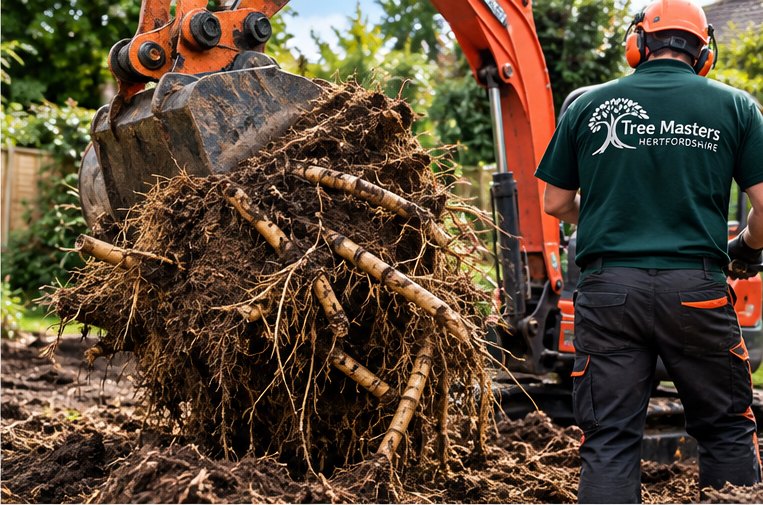
- Excavate the rhizome mass. Typically the top 30 to 50 centimetres across the whole affected area — not just under where the clump was. Machine where access allows, by hand where it does not
- Work outward and chase the runners. Individual rhizomes heading away from the main mass are followed and pulled out rather than cut off at the edge of the dig
- Sift and check the spoil. Fragments left behind are the whole problem, so the ground is gone over rather than simply turned
- Everything off site. No rhizome is composted, chipped for mulch, or moved to another part of the garden
How Deep
Most running bamboo rhizome sits in the top 20 to 40 centimetres, which is why a 30 to 50 centimetre dig covers the great majority of it. Rhizomes go deeper where they have followed something down — alongside a footing, into a soakaway, beside a post hole — and those get followed individually.
The depth matters less than the width. Digging deep in the wrong place achieves nothing; the job is defined by area, not by depth.
Why Fragments Are the Whole Issue
A piece of rhizome with a live bud on it will grow into a new plant. That is what makes bamboo different from most things people want removed — a small amount of material left behind, or scattered by a machine, does not just survive, it re-establishes. It is also why rhizome never goes on a compost heap or into a chipper.
It is why the tidying matters as much as the digging, and why the job includes coming back to deal with anything that appears rather than treating the excavation as the end of it.
Where It Cannot All Come Out
Sometimes the rhizome has gone under something that is staying — a patio, a garage slab, a neighbour's fence line. We will say so plainly rather than pretending otherwise.
In those cases the honest plan is to remove everything that can be reached, install a vertical barrier along the line where it cannot, and expect to deal with a small amount of regrowth for a season or two while what is left exhausts itself.
What About Weedkiller
Chemical control on bamboo is slow and partial. Because the plant is a grass with an enormous energy store underground, a single treatment sets it back rather than killing it, and a programme that genuinely works takes repeated applications over two or three growing seasons.
It has a place where digging is impossible — under a structure, on a slope that cannot be excavated. Where the ground can be dug, excavation is faster, more certain and finished.
The Ground Afterwards
A bamboo excavation leaves an area of disturbed, open soil considerably larger than the clump appeared to be. It wants backfilling and firming, and it is worth leaving it a season before anything permanent goes on top, so that anything missed shows itself while it is still easy to deal with.
View our Hertfordshire Bamboo Removal service →
More Bamboo Removal Advice
Visit the Tree Masters Hertfordshire Advice Centre →
Ask Us About Your Own Garden
Tell us roughly what area the bamboo covers and what is over the top of it — paving, decking, a shed — and we can tell you what the excavation involves.
Tell us what needs doing across Hertfordshire and we will quote for the work. Call 07388 094829, message us on WhatsApp or use the form below.