
Home › Advice Centre › Stump Grinding
This is one of the most common follow-on jobs and one of the easiest to get wrong, because the obvious approach — rake the grindings level, put soil on top, lay turf — produces a lawn with a yellow patch and a dip in it within a year.
Two separate problems cause that, and both are avoidable.
Problem One: Nitrogen
Fresh wood chippings are almost all carbon and very little nitrogen. As soil organisms break them down they draw nitrogen out of the surrounding soil to do it. For as long as that process is running, anything growing in or immediately above the chippings is competing for nitrogen and losing.
The visible result is grass that comes up thin, pale and yellow in exactly the shape of the old stump, while the lawn around it is fine. It corrects itself eventually — over years, not seasons.
Problem Two: Settlement
A hole full of loose grindings has a great deal of air in it. As the wood decays and the material compacts, the volume drops substantially. Turf laid over it goes down with it, and you get a saucer-shaped depression that gets worse for several years.
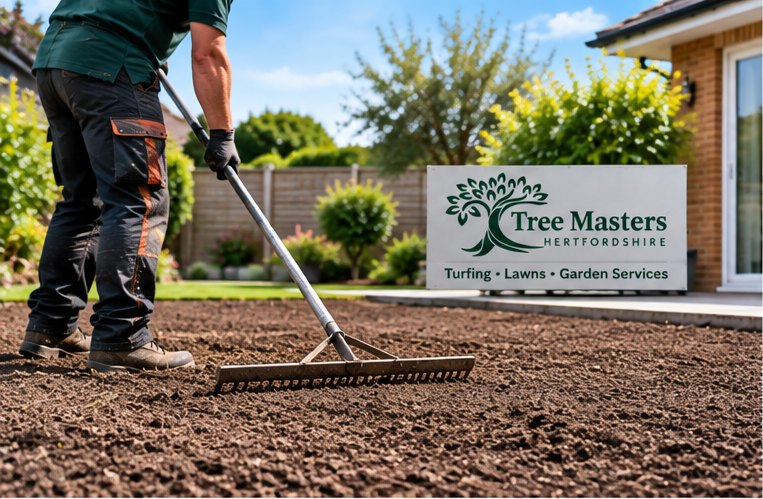
How to Do It Properly
- Take the grindings out. Most of them, not a token amount. They are useful elsewhere as a surface mulch on paths and borders, so this is not waste
- Backfill with clean topsoil and firm it as you go, in layers rather than in one go. Firming matters more than people think — loose backfill is the other cause of settlement
- Overfill slightly. Leave the area a couple of centimetres proud of the surrounding level, because some settlement will still happen
- Let it settle for a few weeks if the timescale allows, then top up any dip before turfing
- Prepare and turf as normal, butting the new turf tight to the existing lawn
If taking the grindings out is not practical, the compromise is to mix them thoroughly through a much larger volume of soil rather than leaving them as a concentrated layer, and to add a nitrogen-rich fertiliser to offset the lock-up. It is a compromise, not a fix, and the patch will still be slightly behind the rest of the lawn for a season.
How Long to Wait
If the grindings have been removed and the hole backfilled with clean soil, you can turf immediately. The waiting period people talk about relates to leaving the grindings in, and in that case the wait is measured in years, which is why removing them is the better answer.
The Roots Are Still There
Grinding takes out the stump and the flare. The lateral roots stay in the ground and decay over several years. Under a lawn this is almost never a problem — occasionally a shallow root leaves a slight line in the turf as it breaks down, which is easily topdressed.
The species worth knowing about are the suckering ones. Poplar, lime, cherry and elm can send up shoots from the remaining root system into a new lawn for a year or two. Mowing deals with them, and they give up eventually.
View our Hertfordshire Stump Grinding service →
More Stump Grinding Advice
Visit the Tree Masters Hertfordshire Advice Centre →
Ask Us About Your Own Garden
If a stump is being ground and turf is going down afterwards, say so at quotation stage — it changes what we do with the grindings and saves you doing it twice.
Tell us what needs doing across Hertfordshire and we will quote for the work. Call 07388 094829, message us on WhatsApp or use the form below.