Home › Advice Centre › Hedge Maintenance
There are two separate questions here and they get tangled together. One is when the hedge will best tolerate a hard cut. The other is when the law allows it. The second one decides most jobs.
The Nesting Season Governs Everything
All wild birds and their active nests are protected. It is an offence to intentionally damage or destroy a nest in use, and hedges are the single most heavily used nesting habitat in a garden. The main season runs from about March to August — earlier for some species, later for others, so the dates are an indication rather than a boundary.
In practice this means heavy reduction work is planned for September to February. Light maintenance trimming within the season is possible, but the hedge has to be checked properly first, and if there is an active nest the work waits.
Within the Legal Window, What the Hedge Prefers
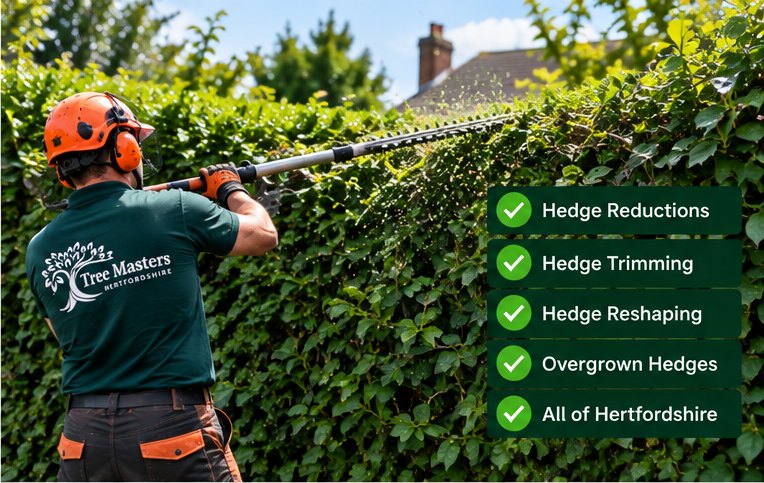
Deciduous hedges — late winter
Beech, hornbeam, hawthorn, blackthorn and mixed native hedges take a hard reduction best in late winter, roughly January to early March. The plant is dormant, the structure is visible with the leaves off, and the regrowth comes away strongly in spring. This is the traditional slot for laying and hard-cutting field hedges and it is the right one.
Laurel and evergreen broadleaves — early spring or autumn
Laurel, holly and privet regenerate readily from old wood and are not fussy. Early spring, just before growth starts, gives the quickest recovery; September also works.
Yew — early spring
Yew is the one conifer that will come back from bare wood, and a hard reduction in early spring gives it the whole season to respond. Even so, yew is slow and a heavy cut takes two or three years to look right again. It is worth it, because the alternative is replacing something that may be a century old.
The One That Will Not Come Back
Leylandii, other cypress, and thuja will not regrow from brown wood. There is no month of the year that changes that. If the green layer has moved outwards past the height or width you want the hedge at, there is no reduction that gets you there and leaves a green hedge.
What can be done is a reduction to the limit of the green, and then a firm annual cut to hold it there. Where that is not close enough to what is wanted, the real choice is between living with it and replacing it — and we would rather say so at the quotation than take the money and leave you with a brown wall.
Doing It in Stages
For a very overgrown hedge of a species that will regenerate, staging the work over two or three years is gentler and produces a better result: one side the first year, the other side once the first has recovered, the top separately. It takes longer and it costs more in total, but a large old hedge that matters is worth treating that way.
Planning around a deadline? If a hedge has to be dealt with before a sale, a letting or building work, start the conversation early. Between the nesting season and the species that want a specific month, the available window can be narrower than people expect.
View our Hertfordshire Hedge Maintenance service →
More Hedge Maintenance Advice
Visit the Tree Masters Hertfordshire Advice Centre →
Ask Us About Your Own Garden
If your hedge needs a hard reduction, tell us the species and we will tell you both when to do it and whether it will take it.
Tell us what needs doing across Hertfordshire and we will quote for the work. Call 07388 094829, message us on WhatsApp or use the form below.