Home › Advice Centre › Hedge Maintenance
Clearing up is part of the job, not an extra, and on a maintenance cut it is a small part of it. On a hard reduction it can be the largest single element of the work, which is worth understanding before comparing two quotations.
How Much There Actually Is
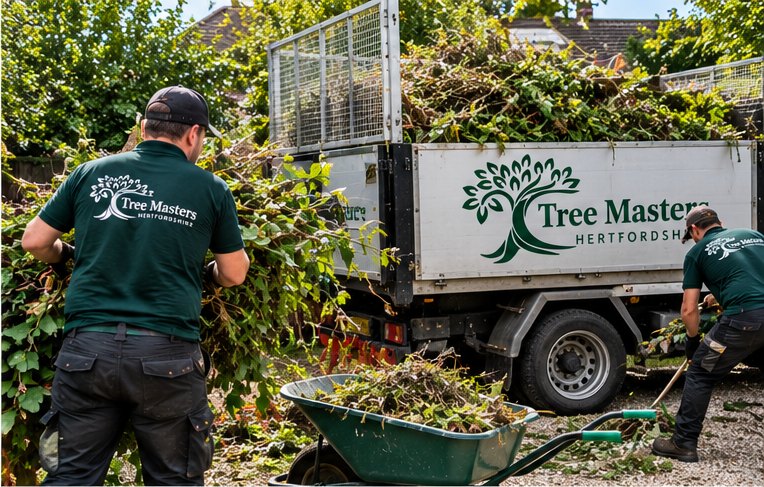
People consistently underestimate this. A year's growth off a garden hedge fills a couple of bags. A metre off the top and sides of a long, neglected boundary hedge is a van load or several, because hedge material is bulky, springy and does not compress until it is chipped or compacted.
Conifer clippings are the worst offender for volume relative to weight. Laurel and holly are heavy. Beech and hornbeam sit in the middle.
What Happens to It
Light clippings from a maintenance cut are collected and taken for composting. Heavier material from a reduction is chipped where the volume justifies bringing a chipper, which reduces it dramatically, and the chip goes for mulch or biomass.
Nothing is burned on site. Garden bonfires of green hedge material produce a great deal of smoke, annoy every neighbour within two streets, and depending on circumstances can amount to a statutory nuisance.
What You Might Want to Keep
- Chip for paths and mulch. Useful, free, and it goes on the surface rather than being dug in
- Light clippings for compost, if you have a heap that can take them. Mix with brown material — a heap of nothing but fresh hedge trimmings turns into a slimy mass
- Brash for a wildlife pile. A stack of hedge material in a shaded corner is genuinely valuable habitat and costs nothing to leave
- Thicker stems for kindling, where a reduction has produced them
Two things that should not go on the compost heap: yew, which is toxic and should not go anywhere animals or children might get at it, and laurel, whose leaves release cyanide compounds as they break down. Both are dealt with separately.
The Legal Part
Garden waste leaving your property as part of a paid job is controlled waste, and the duty of care sits with you as well as with whoever takes it. Anyone removing it commercially must be a registered waste carrier.
The reasonable step is to ask for the registration number, which any legitimate operator will provide without hesitation and which can be checked on the Environment Agency's public register. Waste fly-tipped after leaving your garden can be traced back to the householder, and having paid somebody to take it is not by itself a defence.
If You Would Rather Deal With It Yourself
Perfectly reasonable and it does reduce the price. Be realistic about the volume though, and about what your council's garden waste collection will actually take — most have limits on both quantity and stem thickness, and a hard reduction will exceed them comfortably.
View our Hertfordshire Hedge Maintenance service →
More Hedge Maintenance Advice
Visit the Tree Masters Hertfordshire Advice Centre →
Ask Us About Your Own Garden
Say at quotation stage whether you want the clippings left. It changes the price and it is much easier arranged in advance.
Tell us what needs doing across Hertfordshire and we will quote for the work. Call 07388 094829, message us on WhatsApp or use the form below.