Home › Advice Centre › Ivy Removal
Established ivy has a woody stem at the base that can be as thick as an arm, a mass of adhesive rootlets holding it to whatever it is climbing, and a great deal more material in it than is apparent from the ground. It is not pulled off. It is taken down in a sequence.
The Method
- Sever at the base. The stems are cut through low down and a section of perhaps 10 to 15 centimetres removed, so the top growth cannot simply bridge the cut and reconnect
- Leave it to die back. Several weeks, ideally longer. The foliage dries, the rootlets lose their grip, and the whole mass becomes lighter and far easier to take off
- Clear it, working downward. Dead ivy comes away in sheets. Working from the top down means what is released falls clear rather than pulling the section below it off with the wall attached
- Clean off the residue. Rootlets and the fine brown fuzz they leave behind are brushed off. Some staining on brick usually remains and weathers over a season or two
- Grub out the root crown. The base is dug out where it can be reached, because a cut stem left in the ground will regrow
Why the Waiting Matters
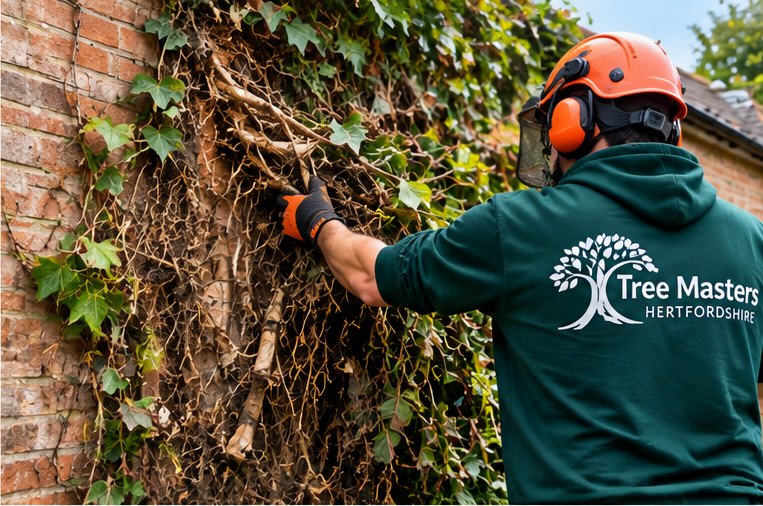
Pulling live ivy off a wall is the single most common way to turn a cosmetic problem into a repair bill. The rootlets are gripping hard, and a live stem pulled downward takes mortar, render, paint and sometimes the face of the brick with it. Severing first, waiting, then clearing does considerably less damage — and less work.
The trade-off is calendar time rather than labour. It is two visits instead of one, several weeks apart. Where somebody wants it gone in a single day, that is possible, but it should be a decision made knowing what the wall will look like afterwards.
The Root Crown
The base of an old ivy is a dense woody crown, often wider than the stems suggest and frequently hidden under a fence line, behind a wall or in a border. Cutting the stem kills what is above it; it does not kill the crown, which will send up new growth.
Where the crown can be dug out, it is. Where it cannot — under a path, against a footing, on a neighbour's side of a boundary — the honest position is that regrowth will need cutting back for a season or two until it exhausts itself, and we will say so rather than imply otherwise.
By What It Is Growing On
- Sound modern brickwork — straightforward. Sever, wait, clear, brush off
- Old lime-mortared brick or stone — the slowest and most careful version. Never pulled; cleared only once thoroughly dead, and some repointing afterwards should be expected rather than treated as a surprise
- Render and painted walls — assume the finish will need making good. Severing and full die-back reduces how much
- Fences and sheds — often the fence is being held together by the ivy, which becomes apparent the moment it is off. Worth being ready for
- Roof edges, fascias and gutters — done from a ladder or tower rather than by pulling from below, and this is where most of the genuinely useful work is
What Not to Do
- Do not use a pressure washer on it. It drives water into every joint it has opened
- Do not burn it off. Obvious, and it still happens
- Do not strim the base and leave the rest. Dead ivy hanging on a wall for years looks worse than live ivy and still traps moisture
View our Hertfordshire Ivy Removal service →
More Ivy Removal Advice
Visit the Tree Masters Hertfordshire Advice Centre →
Ask Us About Your Own Garden
Tell us how high the ivy reaches and what it is growing on. Those two facts decide the method and most of the price.
Tell us what needs doing across Hertfordshire and we will quote for the work. Call 07388 094829, message us on WhatsApp or use the form below.