Home › Advice Centre › Ivy Removal
Ivy that comes back is not a failure of the clearance — it is what happens when the clearance dealt with the growth rather than the plant. The distinction is the whole of this page.
Where the Regrowth Comes From
An established ivy has a woody root crown at ground level, often much larger than the visible stems suggest, with a substantial root system under it. Cut the stems and that crown is untouched, undamaged and holding a full store of energy. It responds exactly as you would expect: new shoots, the following spring, from the same point.
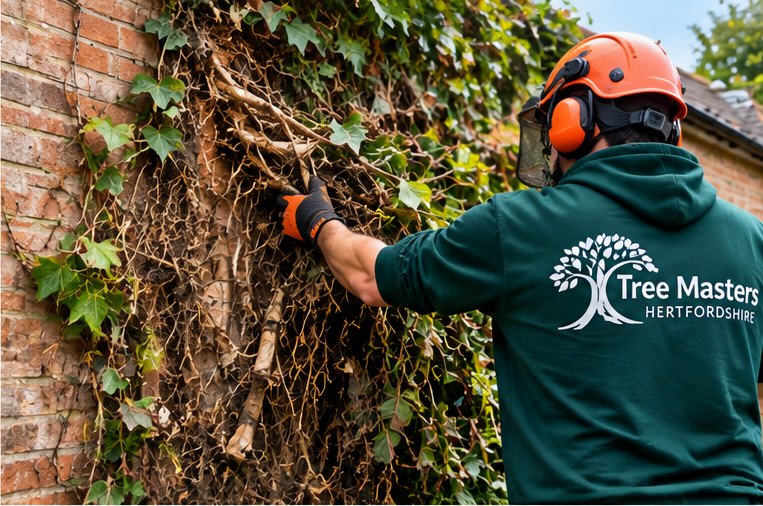
Dealing With the Crown
- Find it. Not always obvious. It may be under a fence line, behind a wall, inside a border, or under paving that the ivy has grown out from beneath
- Dig it out. A proper excavation of the crown and the main roots. This is the part that actually ends it
- Follow the runners. Ivy trailing along the ground roots wherever it touches, so there are frequently several secondary crowns some distance from the original
- Check the neighbouring side. Ivy on your fence very often has its roots on the other side of it, which changes what is possible
When the Crown Cannot Be Reached
Under a path, against a footing, inside a wall, or on a neighbour's land. Then the honest plan is exhaustion rather than removal:
- Cut every new shoot as it appears, not once a year. Each shoot allowed to leaf up repays the crown for producing it
- Expect two to three seasons of this. Ivy has deep reserves and gives up slowly
- Keep a strip clear along the base of whatever it was climbing, so nothing gets established again unnoticed
It works, but it requires somebody to actually do it, which is worth being realistic about before choosing it over digging.
Chemical Control, Honestly
Ivy leaves are waxy and shed most of what is put on them, so spraying intact foliage is largely wasted. Treatment is far more effective applied to freshly cut stems, immediately after cutting, while the plant is still drawing.
Even then it is a supporting measure rather than a solution on an established crown, and it should not be used where the ivy is in a tree, near water, or anywhere it will run off onto planting you are keeping.
Keeping It Off Afterwards
The whole problem restarts at ground level, every time. Ivy has to climb from the soil. A clear strip of 20 or 30 centimetres along the base of a wall or a fence, checked once or twice a year and anything climbing cut through, prevents the entire situation for a few minutes' work. It is the single most effective thing anybody does about ivy.
If You Are Keeping Some
Perfectly reasonable, and it does not mean losing control. Decide where it is allowed — the back wall, the far boundary, the ground under the trees — and cut a clear line where it stops. An annual cut along that line, and along the base of anything it is not allowed on, keeps the good parts and none of the trouble.
View our Hertfordshire Ivy Removal service →
More Ivy Removal Advice
Visit the Tree Masters Hertfordshire Advice Centre →
Ask Us About Your Own Garden
If ivy has come back after being cleared, the base is still there. Tell us where the original stems came out of the ground and we can deal with it properly.
Tell us what needs doing across Hertfordshire and we will quote for the work. Call 07388 094829, message us on WhatsApp or use the form below.