Home › Advice Centre › Ivy Removal
Ivy attracts more strongly held opinions than anything else in a garden, and most of them are too absolute in one direction or the other. It is neither a parasite destroying everything it touches nor an entirely benign native plant that should never be interfered with. It depends on what it is growing on.
Where Ivy Is Not a Problem
- On the ground. As ground cover in a shaded area it is doing a job nothing else does as well, and it is excellent for wildlife
- On sound, well-pointed brickwork. Ivy climbs using adhesive rootlets, not by boring in. On masonry in good repair it is cosmetic
- On a boundary wall you are not precious about, where it is providing cover and shelter
- On a healthy, vigorous mature tree — with real caveats, covered separately
There is a genuine case for leaving it in those situations. Ivy flowers in late autumn when almost nothing else does, fruits in late winter when food is scarce, and provides dense evergreen cover for nesting and roosting all year. In terms of value per square metre it is one of the best things in a garden.
Where It Genuinely Causes Damage
Poor or soft mortar
This is the real one. Where mortar is already soft, crumbling, or lime-based and old, ivy rootlets get into the joints and the growth widens them. It did not create the weakness but it exploits and accelerates it.
The roof edge
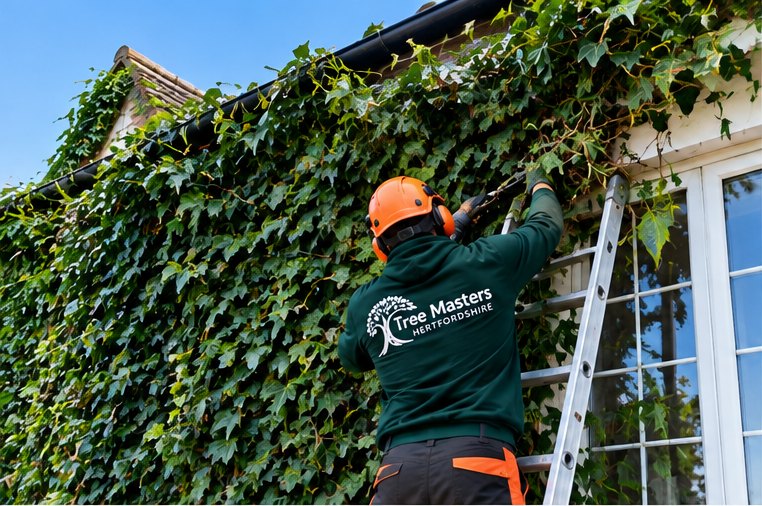
Ivy that reaches the top of a wall does not stop. It gets under the fascia, behind the gutter, under the bottom course of tiles and into the roof space. Most of the expensive damage attributed to ivy on walls actually happened at the roofline.
Render, cladding and painted surfaces
Ivy gets behind render and lifts it, and pulling it off painted or rendered surfaces takes the finish with it.
Windows, doors and anything that moves
It will grow into a window frame, jam a gate and block a vent — airbricks in particular, which matters more than it sounds.
Fences, sheds and outbuildings
Straightforwardly destructive, because the weight and the trapped moisture are acting on something far lighter than a house.
The Test Worth Applying
Two questions settle most cases. Can the ivy get into anything — a soft joint, a gap, under an edge? And is it holding moisture against something that needs to dry — timber, render, a wall with no cavity? If both answers are no, it is doing no harm. If either is yes, deal with it.
The Practical Middle Course
Most gardens do not need a decision between all of it and none of it. The usual sensible outcome is:
- Take it off the building entirely, and particularly off the roof edge
- Take it off fences, sheds and anything timber
- Cut it out of trees where it has reached the crown, or where the trunk needs inspecting
- Leave it on the ground, on boundary walls and in the corner where it is doing nobody any harm
That keeps the value and removes the risk, and it is usually cheaper than clearing the lot.
View our Hertfordshire Ivy Removal service →
More Ivy Removal Advice
Visit the Tree Masters Hertfordshire Advice Centre →
Ask Us About Your Own Garden
Send a photograph of where the ivy meets the building — the roof edge and the gutter line especially. That is where the answer usually is.
Tell us what needs doing across Hertfordshire and we will quote for the work. Call 07388 094829, message us on WhatsApp or use the form below.