Home › Advice Centre › Tree Surgery
Most trees that people ring up worried about turn out to be healthy trees behaving normally. And occasionally a tree nobody had thought about at all has a defect at the base that matters a great deal.
So it is worth knowing what to actually look at.
The Things That Warrant a Prompt Look
Movement at the base
The most serious sign there is. Soil lifting, cracking or doming on the opposite side to the lean, or a visible gap opening between the trunk and the ground, means the root plate is moving. That is not a wait-and-see.
A lean that is new, or getting worse
Plenty of trees lean and always have. The question is whether it has changed. A tree that has visibly moved after a gale is a different matter from one that has grown at an angle for thirty years.
Fungal brackets on the trunk or root flare
Bracket fungi fruiting from the main stem or the base generally indicate decay inside. Which fungus it is matters — some are far more significant than others — so it is worth a photograph rather than a guess.
Splits and cracks
Particularly a split at a fork where two stems of similar size meet. That is a structurally weak union to begin with, and a crack opening in it is a genuine warning.
Large dead limbs over something that matters
Deadwood high in a crown over a lawn is a low-consequence issue. The same limb over a driveway, a footpath, a road or a house is not.
Sudden thinning or early leaf drop
A crown that is noticeably sparser than it was, or that drops its leaves weeks before neighbouring trees of the same species, is telling you something about the roots or the vascular system.
Ash trees in particular
Ash dieback is widespread across Hertfordshire. Affected ash lose crown density from the top down, and as they decline the timber becomes brittle and progressively more dangerous to work on. An ash with a thinning crown is better dealt with earlier than later, for exactly that reason.
Things That Look Alarming and Usually Are Not
- Dropping small twigs and branches. Normal, especially in summer and especially on oak
- Ivy on the trunk. Ivy is not a parasite and is not killing the tree. It can hide defects and it adds wind loading, both of which are worth knowing about, but its presence is not itself a problem
- Moss and lichen. Harmless. They grow on healthy bark
- Bark falling off plane trees. That is what plane trees do
- A hollow trunk. Counter-intuitive, but a hollow tree is not automatically unsafe — a tube is a strong structure. What matters is how much sound wood is left around the hollow
- Roots visible at the surface. Normal on many species and on compacted ground
When to Do Something Straight Away
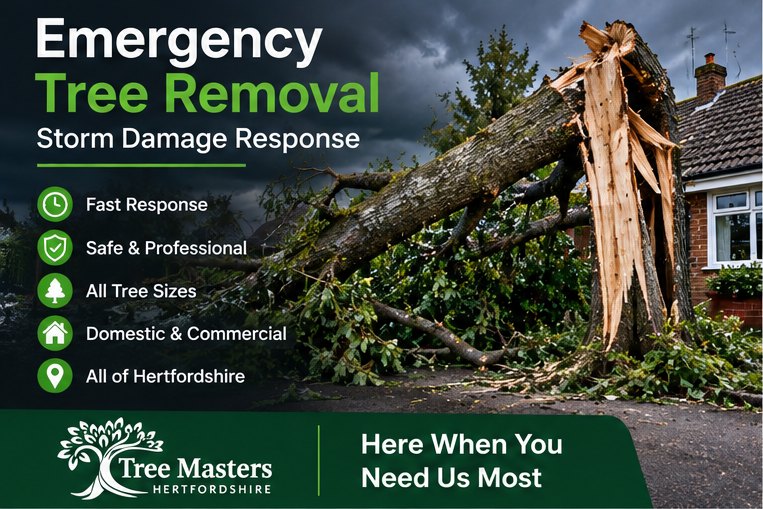
Do not wait for a convenient time if a tree has moved after a storm, if there is soil lifting at the base, if a large limb is hanging or partly detached, or if there is a fresh split at a main fork. Keep people away from underneath it and get it looked at.
If you are having a look yourself: stand well back and look at the whole tree first, then walk right up and look at the bottom metre and the ground around it. Those two views catch most of what matters. A photograph of each is what we would want to see.
Whose Responsibility Is It
A tree owner has a duty to take reasonable care that their tree does not cause harm. That does not mean a survey every year for an ordinary garden tree. It does mean that if something is visibly wrong and it has been ignored, that is harder to defend. Having a look at a large tree periodically, and dealing with what you find, is the reasonable standard.
View our Hertfordshire Tree Surgery service →
More Tree Surgery Advice
Visit the Tree Masters Hertfordshire Advice Centre →
Ask Us About Your Own Garden
If something on this page describes your tree, send a photograph — the whole tree from a distance, plus the base. We will tell you whether it needs looking at.
Tell us what needs doing across Hertfordshire and we will quote for the work. Call 07388 094829, message us on WhatsApp or use the form below.