Home › Advice Centre › Tree Surgery
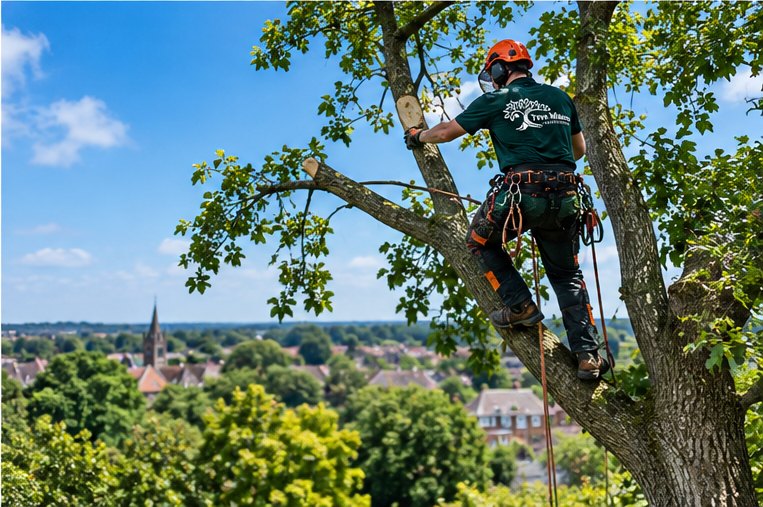
Crown reduction means making the crown of a tree smaller while keeping its natural shape. Not cutting it off at a height — reducing it, evenly, all over, so that afterwards it looks like the same tree, smaller.
How It Is Actually Done
Each branch being shortened is cut back to a point where there is a suitable side branch to take over as the new leading growth. That side branch needs to be big enough relative to the wood being removed — the convention is roughly a third of the diameter — because it now has to draw the sap and seal the wound.
Work through the whole crown doing that, and the tree ends up perhaps a couple of metres smaller in every direction, with an outline that still reads as a tree of that species.
Why This Is Not Topping
Topping is cutting the main stems off at a convenient height, without regard to what is growing there. It is quicker and cheaper and it produces a dramatic result, which is why it still gets sold.
What it leaves is a set of stubs with no growth point to take over. The tree responds to losing most of its leaf area by throwing out a mass of fast vertical shoots from dormant buds just below the cuts. That regrowth is:
- Attached to the outside of the old wood rather than growing from the structure, so it is weakly held and prone to tearing out
- Faster than the original growth, so the tree is back to its previous height in a few years, denser and heavier than before
- Growing out of a wound the tree cannot seal, because a stub cut into old wood has no mechanism to close over. Decay gets in behind it
A topped tree is more likely to fail than it was before, not less. That is the opposite of what topping is usually sold as achieving. It is also more expensive over time, because the regrowth needs dealing with repeatedly and eventually the tree needs removing.
There is a narrow and legitimate exception: pollarding, where a tree is cut back to the same points on a regular cycle, starting when the tree is young. A pollard maintained properly from the beginning is a long-lived, stable form. It is not the same as topping a mature tree once and walking away.
When Reduction Is the Right Answer
- The crown has grown over a roof, a conservatory or a boundary
- The tree is casting more shade than the garden can carry
- It is in an exposed position and the wind loading is a concern
- A long lateral limb is carrying too much end weight
- The tree is large enough that its scale has become uncomfortable relative to the house
How Much Can Come Off
As a rule of thumb, up to around a quarter to a third of the crown in one go on a healthy tree. Beyond that you are into territory where the tree's response is a stress response rather than normal growth, and where finding suitable growth points to cut back to becomes difficult — which is the point at which reduction quietly turns into topping.
Older trees tolerate less. A very mature specimen is better given a light reduction repeated over years than a heavy one in a single visit.
The Related Techniques
- Crown thinning — removing a proportion of the branches throughout the crown without changing its size or outline. This is the one for light, and it does not make the tree smaller
- Crown lifting — removing the lowest branches to raise the clearance underneath. Useful over a path, a drive or a lawn
- Deadwooding — taking out the dead material and leaving the live crown alone. Often the whole answer where the concern is things falling
Quite often somebody asks for a reduction when thinning or lifting is what would actually solve their problem, and it is worth saying so — both are less work and less intervention.
View our Hertfordshire Tree Surgery service →
More Tree Surgery Advice
Visit the Tree Masters Hertfordshire Advice Centre →
Ask Us About Your Own Garden
If somebody has offered to “top” your tree and you are not sure what you are being sold, describe it to us and we will explain what the two approaches would each leave you with.
Tell us what needs doing across Hertfordshire and we will quote for the work. Call 07388 094829, message us on WhatsApp or use the form below.