Home › Advice Centre › Tree Surgery
Trees turn up in property transactions in three ways: through the survey, through the lender, and through whoever is going to live there. They are quite different problems and they want different work doing.
What a Survey Picks Up
A surveyor is looking for anything that could cause damage or cost. On trees, that means:
- Large trees close to the building, particularly on shrinkable clay — which covers a good deal of Hertfordshire
- Branches in contact with the roof, the gutters or the render
- Obvious structural defects, decay or significant deadwood
- Trees over a boundary that are plainly somebody's future argument
The items in that list that can be dealt with cheaply — clearing branches off the building, removing deadwood — are worth doing before the survey rather than after. A clean report is easier than a report with a caveat you then have to negotiate around.
One thing to be careful about: removing a large tree near a building on clay soil is not automatically the safe option. Ground that has been kept dry by a mature tree for decades can swell when the tree goes, and heave has caused more than one expensive problem. Where a large tree sits close to a house on clay, that is a question for specific advice, not a general tidy-up.
What Actually Affects a Viewing
Less than people spend on it, but not nothing. What registers with a buyer in the first minute is light and tidiness, not tree health:
- A dark garden reads as small. Thinning or lifting a crown to get light in changes the feel of a garden more than almost anything else you can do for the money
- A tree pressed against the house looks like a problem, whether or not it is one
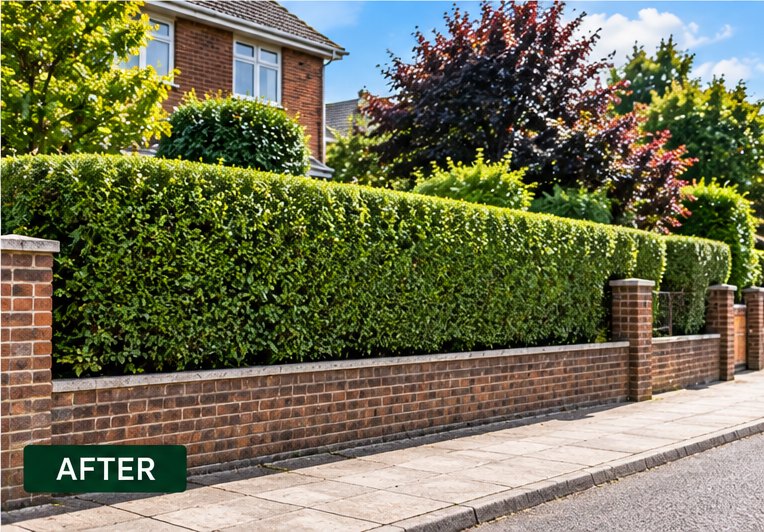
- Hedges cut square and level make a garden look maintained. Overgrown boundaries make it look like a job
- Stumps and dead trees read as neglect, fairly or otherwise
Crown lifting is usually the best value of these. It is a modest amount of work, it does not change the tree, and it noticeably opens up a garden.
Letting: a Different Set of Priorities
For a rental, the question is not what impresses at a viewing. It is what will generate a call in eighteen months' time.
- Deal with anything that could fall. Deadwood, unstable limbs, anything leaning over a garden a tenant will use. This is the responsibility that does not transfer with the tenancy
- Reduce the maintenance burden to something realistic. A tenant will not manage a large hedge. Cutting it hard before they move in buys you a couple of years
- Get it to a defined state and photograph it. The condition at the start of a tenancy is what you will be comparing against at the end
- Decide who does the garden and write it down. Most disputes about gardens are really disputes about what the agreement said
Timing, Which Is Usually the Problem
Two things routinely catch people out on a deadline:
- Protected trees. If the tree has an order on it or sits in a conservation area, there is a statutory process with a waiting period. That is weeks, and it cannot be compressed because you have exchanged
- Nesting season. Roughly March to August. Heavy hedge cutting and some tree work has to work around it
Both are reasons to start the conversation earlier than feels necessary.
What Is Usually Not Worth It
Removing a healthy mature tree to make a garden lower-maintenance rarely pays for itself, and for some buyers it actively devalues the property. A good tree is a selling point. Reducing it so it stops dominating is the better version of that instinct.
View our Hertfordshire Tree Surgery service →
More Tree Surgery Advice
Visit the Tree Masters Hertfordshire Advice Centre →
Ask Us About Your Own Garden
If you have a date to work to, say so when you enquire. It affects what is worth doing and what can realistically be finished in time.
Tell us what needs doing across Hertfordshire and we will quote for the work. Call 07388 094829, message us on WhatsApp or use the form below.