
Home › Advice Centre › Tree Surgery
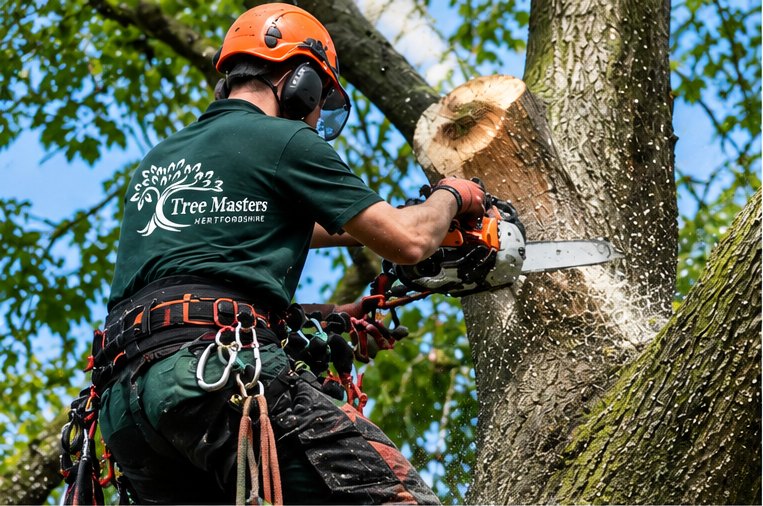
Winter is the default answer, and for most garden trees in Hertfordshire it is the right one. The tree is dormant, the leaves are off so the structure is visible, and there is no nesting to work around. Anything from roughly November to late February is comfortable.
But “most trees” is doing some work in that sentence. There are a handful of species where winter is the wrong choice, and one legal constraint that overrides the calendar entirely.
The Two Rules That Are Not Negotiable
Nesting birds
All wild birds, their active nests and their eggs are protected. It is an offence to intentionally damage or destroy a nest while it is in use, and the main season runs from around March to August — though some species start earlier and some run later, so the dates are a guide rather than a permission slip.
This does not mean no tree work happens in summer. It means the tree is checked before anything is cut, and if there is an active nest the work waits or is confined to the parts of the tree that can be done without disturbing it. Urgent safety work is a different matter and is dealt with on its own terms.
Protected trees
If the tree carries a Tree Preservation Order, or sits in a conservation area, the timing question is secondary — the consent or notification has to be dealt with first, and that takes weeks rather than days. Worth establishing before you plan around a particular month.
Species Where Winter Is the Wrong Answer
Some trees move sap so strongly in late winter and early spring that a cut made then will run for weeks. It rarely kills the tree, but it is messy, it looks alarming, and it is avoidable.
- Birch and maple — including sycamore and field maple. These bleed heavily from late winter. Prune them in mid to late summer, once the leaves are fully out and the sap pressure has dropped
- Walnut — same problem, same answer: late summer
- Cherry, plum and other ornamental Prunus — these are pruned in summer for a different reason entirely. Silver leaf disease and bacterial canker both infect through winter wounds, so summer cutting is a disease precaution rather than a cosmetic one
Trees Where Timing Affects Next Year's Flowers
If a tree flowers on wood it grew the previous year, cutting in winter removes the flower buds along with the wood. You get a tidy tree and no blossom.
Magnolia is the one people regret most. Prune it, if at all, shortly after flowering. The same principle applies to most spring-flowering ornamentals: cut them once the flowers have gone over, not before.
The practical version: winter for oak, ash, lime, hornbeam, beech, chestnut, most conifers and most large shade trees. Summer for birch, maple, walnut and anything in the cherry family. Just after flowering for spring ornamentals. Any month for genuine safety work.
When the Calendar Does Not Apply
A tree that has a problem does not wait for the right month. A limb that has split, a tree that has moved in a gale, storm damage hanging in a crown, a branch over a road or a roof that has become unsupported — those are dealt with when they are found.
The seasonal advice on this page is about doing discretionary work at the time that suits the tree best. It is not a reason to leave something unsafe until November.
How Often, Rather Than When
Timing gets asked about far more than frequency, and frequency is usually the more useful question. Most established garden trees do not need annual attention. A reduction or a thinning done properly will hold its shape for several years, and cutting the same tree every season tends to produce dense, congested regrowth rather than a better tree.
The exceptions are trees being deliberately maintained at a size — pollards, and formal shapes — which do need a regular cycle, because the whole point of them is that they are kept to a form they would not naturally hold.
View our Hertfordshire Tree Surgery service →
More Tree Surgery Advice
Visit the Tree Masters Hertfordshire Advice Centre →
Ask Us About Your Own Garden
If you are unsure whether now is the right month for your particular tree, tell us what it is and we will say so plainly — including if the answer is to wait.
Tell us what needs doing across Hertfordshire and we will quote for the work. Call 07388 094829, message us on WhatsApp or use the form below.